Climate and environment
Climate protection and child protection go hand in hand
Climate change - or rather the climate crisis - is on everyone's lips. What exactly does it mean when the climate changes? And what does all this have to do with SOS Children's Villages?
Thousands of families are forced to leave their homes as poverty increases dramatically due to climate change and they hope for better living conditions elsewhere. This number will grow dramatically: A recent study by the World Bank speaks of 140 million climate migrants in 2050, the vast majority of whom will remain in their own countries after leaving their home regions.
This is the link between the climate crisis and the work of SOS Children's Villages: The consequences of global warming are particularly threatening to people who are often already living at subsistence level. Farmers, people who live from fishing and nomadic families must flee to the cities because of the climatic changes. They become climate migrants who often slip deeper into poverty in the poor districts of the big cities. It is especially the children of these families who suffer from the climate crisis.
To ensure that children can grow up in safety, we support families in regions particularly affected by climate change and work to preserve their livelihoods so that they don’t have to flee in the first place.
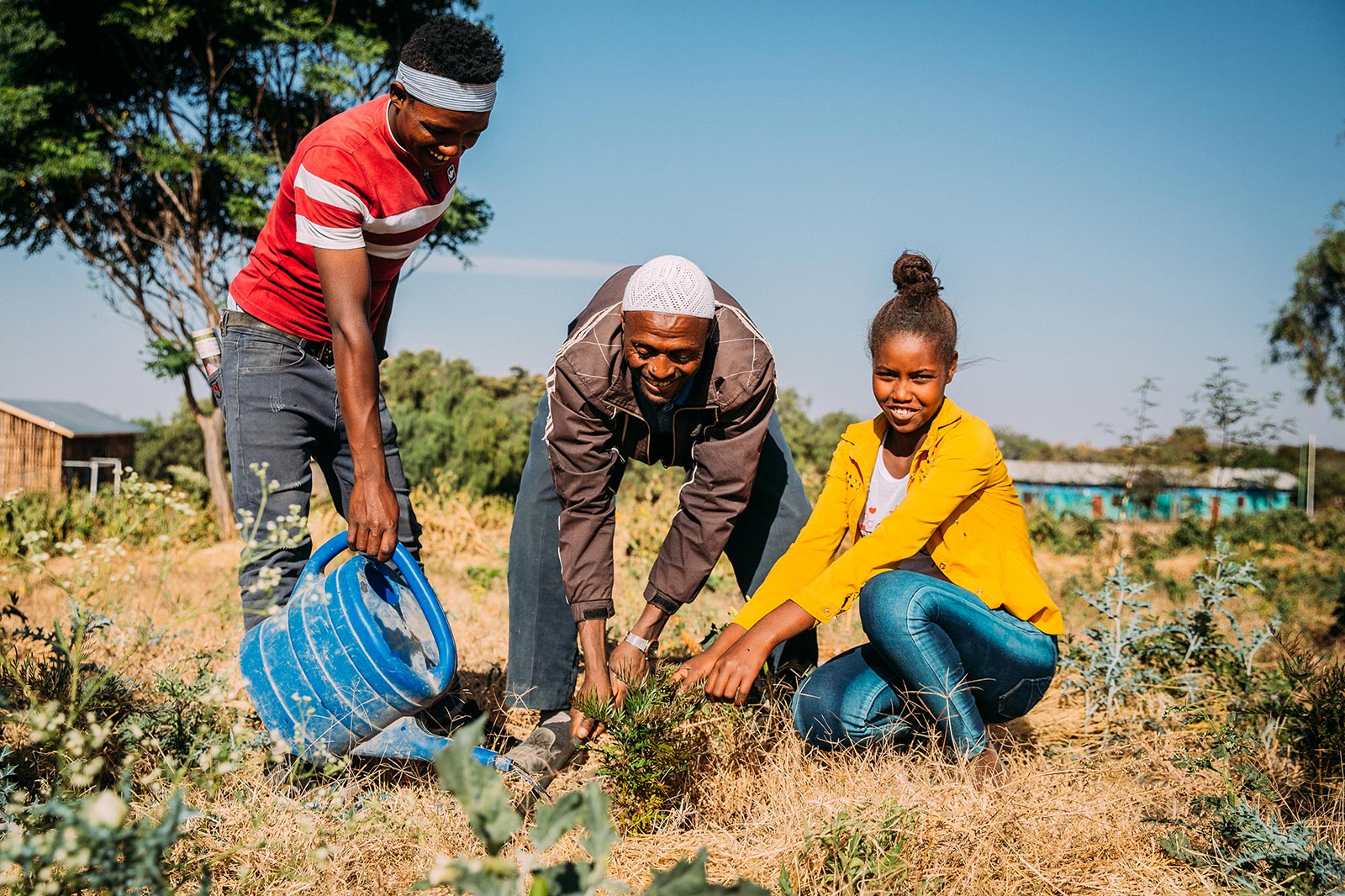 We educate young people and families so that they can better adapt to climate change. Photo: Alea Horst
- Our model: combining environmental protection and poverty reduction
SOS Children's Villages protect children worldwide. In most cases this means fighting the poverty of their parents. Poverty can have various causes - including climate change. For those who are deprived of their livelihoods by climate change, we need to find solutions. Our projects are holistically conceived: We support families in arming themselves against the consequences of climate change by working with them to increase soil fertility, installing water-saving irrigation techniques or providing drought-resistant seeds. - The children receive environmental education. We train young people and adults for sustainable professions to broaden their job prospects and transform SOS Children's Villages to be environmentally and climate friendly. Being able to support climate protection is a very privileged situation. Those who are faced with the choice of being able to feed their own children or protecting the climate probably usually choose the former. That is why it is so important to offer people not only knowledge about the climate crisis but also alternatives to climate-damaging lifestyles.
- CO2-neutral stoves and women's empowerment against deforestation
To counteract deforestation in Uganda, we are working with local communities to teach women's initiatives how to build energy-saving stoves and produce pellets from biomass, i.e., leaves and branches. In Uganda, cooking with wood is widespread - the people harvest the fuel from the forests. By making pellets from biomass, we counteract deforestation; and the stoves are a CO2-neutral solution for cooking. The women earn an income by selling the stoves and pellets. In addition, the low-smoke stoves reduce health hazards. - Hydroponics: Vertical gardens ensure food safety
In Zambia, many rural families are poor. Malnutrition is a common problem. The droughts of recent years have exacerbated hunger. Therefore, SOS Children's Villages support small farmers in developing sustainable and water-saving cultivation methods: Instead of growing in the field, the plants are cultivated in vertical plastic pipes and a closed water circuit is installed. These so-called hydroponics are much more water-efficient than traditional farming. In addition, this method of cultivation makes the families independent in periods of drought or heavy rainfall, as well as frees them from pesticides. No matter whether in the slum or in the countryside, this method of cultivation makes the people independent from the rainy seasons, and at the same time it solves the problem of malnutrition. We want to train young people in using this method of cultivation: in this way they gain a lot of new knowledge and can earn their living with "green" jobs. - Offering children a secure future
With projects like these, SOS Children's Villages actively contribute to securing a good basis of life for children worldwide. Because children and young people can only grow up safely on a healthy planet, we all have to prepare for a world with a changed climate. It is above all the coming generations who will have to live with it

Young people start climate projects worldwide
All over the world, young people are getting involved in climate protection. SOS Children's Villages' Eco Champions initiative connects young people in the Global South and helps them to expand and professionalise their actions.
Help children in need!
Give children in need a future: Help with your donation or sponsorship!